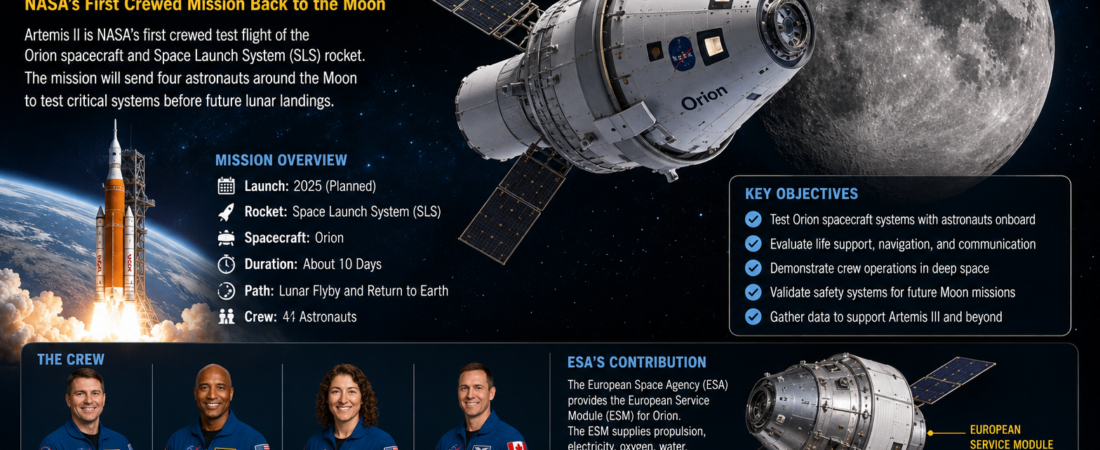
After more than 50 years since the Apollo era, NASA is preparing to send astronauts around the Moon once again through the Artemis II mission. As the first crewed flight in the Artemis programme, Artemis II will test the Orion spacecraft and its systems in deep space before future lunar landings. The mission represents a major milestone in international space exploration, bringing together NASA, the European Space Agency (ESA), the Canadian Space Agency (CSA), and other partners.
In this guide, you’ll learn what Artemis II is, its mission objectives, the Orion spacecraft, and why this historic mission is so important for the future of human exploration.
What Is Artemis II?
Artemis II is NASA’s first crewed mission under the Artemis programme. Unlike Apollo missions that aimed to land astronauts on the Moon immediately, Artemis II focuses on testing every critical system with astronauts on board before attempting future lunar landings.
The mission will launch aboard NASA’s powerful Space Launch System (SLS) rocket, carrying four astronauts inside the Orion spacecraft. Instead of landing on the Moon, the crew will travel around it and return safely to Earth, completing a journey of several days through deep space.
The knowledge gained during Artemis II will directly support Artemis III, the mission planned to return humans to the lunar surface.
Main Objectives of Artemis II
Artemis II has several important goals that will prepare NASA for long-duration human missions beyond Earth orbit.
These objectives include:
- Testing Orion’s life-support systems with astronauts onboard.
- Evaluating spacecraft navigation and communication in deep space.
- Demonstrating crew operations during a lunar flyby.
- Validating safety systems for future Moon missions.
- Collecting valuable engineering and scientific data.
Every stage of the mission is designed to ensure astronauts can safely travel farther from Earth than any human has in decades.
The Orion Spacecraft
The Orion spacecraft is NASA’s next-generation vehicle for deep-space exploration. It is specifically designed to carry astronauts beyond low Earth orbit and support future missions to the Moon and eventually Mars.
Orion includes:
- A crew module where astronauts live and work.
- Advanced navigation and communication systems.
- Emergency safety features.
- Heat shield technology capable of surviving the extreme temperatures of Earth’s re-entry.
One of Orion’s most important components is the European Service Module (ESM), built by the European Space Agency (ESA). The ESM provides propulsion, electrical power, oxygen, water, and thermal control, making it essential for the mission’s success.
Who Is Flying on Artemis II?
The Artemis II crew consists of four experienced astronauts representing international cooperation in space exploration:
- Commander Reid Wiseman
- Pilot Victor Glover
- Mission Specialist Christina Koch
- Mission Specialist Jeremy Hansen of the Canadian Space Agency
Their mission will demonstrate how astronauts can safely operate in deep space while preparing for future lunar surface expeditions.
Why Artemis II Matters
Artemis II is more than another space mission—it is the foundation for humanity’s return to the Moon.
The mission will help scientists and engineers verify that both the Space Launch System and Orion spacecraft are ready for regular human exploration beyond Earth orbit. It also strengthens international partnerships, with ESA contributing the European Service Module and Canada providing one of the mission’s astronauts.
The technologies and operational experience gained during Artemis II will also support future missions aimed at building a long-term human presence on the Moon through the planned Lunar Gateway and eventually sending astronauts to Mars.
Looking Ahead
If Artemis II successfully completes its objectives, NASA will move closer to launching Artemis III, which aims to land astronauts near the Moon’s south pole. These missions are expected to unlock new scientific discoveries, test advanced technologies, and prepare humanity for even deeper exploration of the Solar System.
Conclusion
Artemis II marks an exciting new chapter in human spaceflight. By sending astronauts around the Moon aboard the Orion spacecraft, NASA and its international partners will validate the systems needed for future lunar landings and deep-space missions.
As the first crewed Artemis mission, Artemis II bridges the gap between successful uncrewed testing and humanity’s return to the lunar surface. Its success will lay the groundwork for sustainable exploration of the Moon and, ultimately, future journeys to Mars.