A satellite communication system is a network that uses satellites to transmit voice, video, internet traffic, telemetry, commands and other types of data between different locations on Earth or between spacecraft.
Unlike traditional terrestrial communication, which mainly depends on fiber-optic cables, cellular towers and other ground infrastructure, satellite communication can provide connectivity across oceans, mountains, deserts and remote regions where terrestrial networks may be difficult or expensive to deploy.
A modern satellite communication network is more than just a satellite in space. It can include communication satellites, antennas, ground stations, satellite modems, gateways, routers, network operations centers and user terminals.
The basic communication path is:
User/Data Source → Ground Network → Uplink → Satellite → Downlink → Ground Station → Network Routing → Final User
Understanding this complete architecture helps explain how information can travel from a device on Earth to a satellite and then back to another location.
What Is a Satellite Communication System?
A satellite communication system is a communication network in which an artificial satellite provides a link for transmitting information between two or more locations.
In a basic satellite communication system, information is transmitted from Earth to a satellite through an uplink. The satellite receives the signal and, depending on its architecture, processes, amplifies, routes or retransmits it. The information then travels back toward Earth through a downlink.
A simplified communication path is:
Source → Ground Station → Uplink → Satellite → Downlink → Ground Station/User
Modern satellite networks can be considerably more sophisticated. They may contain multiple satellites, gateway stations, user terminals, network routers and inter-satellite links that allow spacecraft to exchange data directly.
How Does Satellite Communication Work?
The complete process can be understood through several stages.
1. Data Is Generated
The process starts when a device, person, organization or system generates information.
The data may include:
- Internet traffic
- Voice calls
- Video
- Television programming
- Satellite imagery
- Weather information
- Scientific measurements
- Telemetry
- Navigation-related information
- Control commands
- Industrial sensor data
Before transmission, the information is processed into a signal suitable for the communication system.
2. Data Reaches a Ground Station or User Terminal
The data is passed to communication equipment on Earth.
Depending on the network, this may be a large ground station, a gateway facility or a smaller user terminal.
A ground station can contain equipment such as:
- Antennas
- RF transmitters
- RF receivers
- Satellite modems
- Amplifiers
- Filters
- Tracking equipment
- Network interfaces
- Computers and control systems
The equipment prepares the information for transmission toward the satellite.
3. The Signal Travels Through the Uplink
The Earth-to-satellite communication path is called the uplink.
The transmitting system performs functions such as modulation, frequency conversion and amplification before sending the radio-frequency signal through an antenna.
A high-gain antenna directs the signal toward the satellite.
Ground Station → Uplink → Satellite
4. The Satellite Receives the Signal
The satellite receives the incoming signal through its communication antenna.
The communication payload can contain receivers, filters, frequency converters, amplifiers, transmitters and other signal-processing equipment.
The exact architecture depends on the type of satellite.
Traditional communications satellites often use a bent-pipe architecture, where the satellite receives a signal, changes its frequency, amplifies it and retransmits it toward Earth.
More advanced satellites can perform additional processing and routing functions onboard.
5. The Transponder Processes the Signal
A satellite transponder is an important component in many traditional satellite communication systems.
Its basic role is to receive an incoming signal and retransmit it on another frequency.
A simplified transponder chain can be represented as:
Receive Antenna → Filter → Low-Noise Amplifier → Frequency Conversion → Amplification → Transmit Antenna
Modern satellite systems can use more advanced digital payloads, so the exact processing chain is not identical for every satellite.
6. The Satellite Sends the Signal Back to Earth
After the required processing, the satellite transmits the signal toward its destination on Earth.
This satellite-to-Earth communication path is called the downlink.
The satellite antenna and beam design determine how the signal is directed and which geographical region can receive it.
The downlink may contain internet traffic, television signals, telemetry, scientific information, images or other forms of data.
7. The Ground Station Receives the Downlink
A receiving ground station uses an antenna to capture the signal from the satellite.
Large parabolic antennas are commonly used in many satellite communication applications because they provide high gain and accurate pointing.
The received signal is then processed, demodulated and decoded.
At this point, the information becomes usable network data.
8. Data Is Routed to the Final Destination
Receiving the satellite signal is not necessarily the end of the communication process.
The decoded data may need to travel through additional network infrastructure before reaching the final destination.
This is where data routing becomes important.
A modern satellite network may use routers, gateways and network-management systems to determine where data packets should go.
The complete path can therefore look like:
User Device → Local Network → Satellite Terminal → Ground Gateway → Satellite Link → Ground Gateway → Network Router → Internet/Data Center → Final User
The routing layer can help manage factors such as:
- Available network paths
- Bandwidth
- Latency
- Link quality
- Network congestion
- Reliability
- Security requirements
This means satellite communication is not simply about sending a signal into space. It is a combination of space communication, ground infrastructure and network routing.
Satellite Communication System Architecture
A typical satellite communication architecture can be divided into several major sections.
Space Segment
The space segment contains the satellite or satellite constellation and its communication payload.
Ground Segment
The ground segment contains Earth-based infrastructure such as ground stations, gateway stations, antennas and network equipment.
User Segment
The user segment includes terminals and devices that access the satellite communication service.
A simplified architecture is:
User → User Terminal → Ground Gateway → Uplink → Satellite → Downlink → Ground Gateway → Router → Internet/Data Network
In a constellation-based network, the architecture may additionally include:
Satellite → Inter-Satellite Link → Satellite → Ground Gateway
This allows data to travel between spacecraft before reaching a ground station.
Main Components of a Satellite Communication System
1. Communication Satellite
The satellite is the space-based component of the system.
A communication satellite can contain antennas, communication payloads, power systems, computers, thermal-control systems and other subsystems.
The communication payload handles the functions required to receive and transmit information.
2. Satellite Antenna
Antennas transmit and receive radio signals.
Satellite antennas are designed according to the required frequency, coverage area, gain and communication architecture.
A satellite may have multiple antennas serving different beams or communication functions.
3. Transponder
The transponder receives an uplink signal and retransmits it through the downlink.
Traditional transponders commonly perform functions such as filtering, amplification and frequency conversion.
Modern digital payloads may perform considerably more processing onboard.
4. Ground Station
A ground station provides the connection between Earth-based networks and satellites.
Typical ground-station equipment includes:
- Parabolic antenna
- RF transmitter
- RF receiver
- Satellite modem
- Amplifiers
- Filters
- Tracking system
- Network equipment
- Monitoring and control systems
Ground stations can also connect satellite networks to terrestrial networks, data centers and internet infrastructure.
5. Satellite Modem
A satellite modem performs important communication signal-processing functions.
Depending on the system, it can handle modulation, demodulation, coding, decoding and other functions required to convert between digital network data and the radio communication signal.
6. Antenna Tracking System
Many satellite links require accurate antenna pointing.
A tracking system helps a ground antenna maintain the correct alignment with a satellite, particularly when communicating with satellites that move across the sky relative to the ground station.
7. Network Gateway
A gateway provides an interface between a satellite network and other networks.
For example, a satellite internet network may use a gateway to connect satellite traffic to terrestrial internet infrastructure.
8. Network Router
Routers determine how data packets move through a network.
In satellite communication, routers can connect satellite gateways with terrestrial networks, data centers, enterprise networks or other destinations.
This is particularly important in complex networks involving multiple links and gateways.
9. Network Operations Center
Large satellite networks require monitoring and management systems.
A network operations center can help operators monitor connectivity, configure network resources, identify problems and manage network performance.
10. User Terminal
A user terminal provides the communication interface for the end user.
Depending on the application, it may contain an antenna, modem, router and other networking equipment.
User terminals can be installed at homes, offices, ships, aircraft, remote industrial locations and other sites.
Satellite Communication Signal Flow Diagram
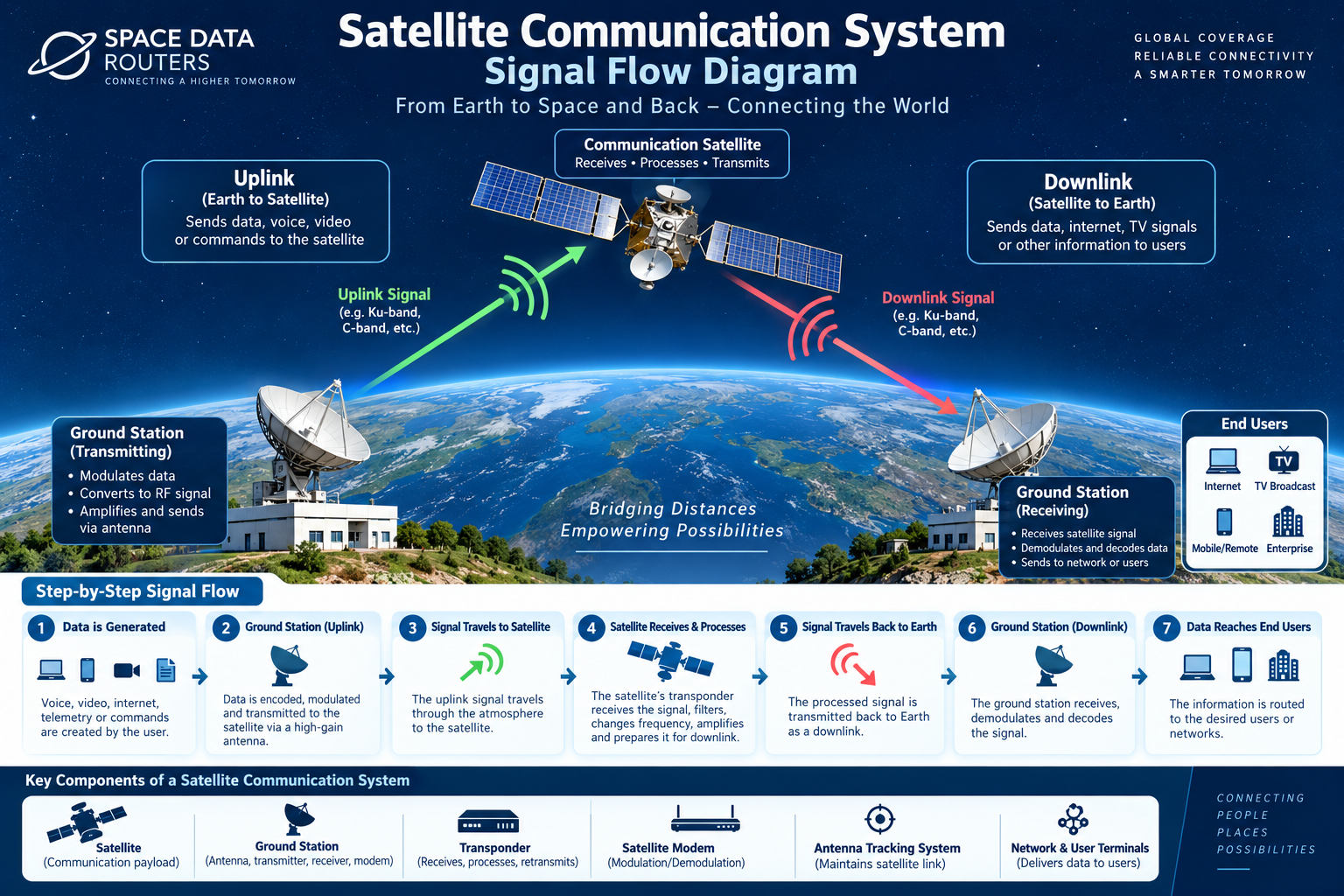
The complete signal flow can be summarized as:
1. Data Generated
↓
2. Ground Station / User Terminal
↓
3. Uplink Signal
↓
4. Communication Satellite
↓
5. Transponder / Onboard Processing
↓
6. Downlink Signal
↓
7. Receiving Ground Station
↓
8. Network Router / Gateway
↓
9. Internet, Data Center or Final User
This flow shows why both satellite technology and terrestrial networking are important to modern satellite communication.
Uplink vs Downlink
Two of the most important terms in satellite communication are uplink and downlink.
| Feature | Uplink | Downlink |
|---|---|---|
| Direction | Earth → Satellite | Satellite → Earth |
| Purpose | Sends information to the satellite | Sends information toward Earth |
| Typical source | Ground station/user terminal | Satellite |
| Typical destination | Satellite | Ground station/user |
| Example | Data transmitted toward satellite | Internet or telemetry data received on Earth |
Some advanced systems also use inter-satellite links, allowing satellites to exchange information directly.
What Are Satellite Communication Frequency Bands?
Satellite systems operate across different radio-frequency bands depending on the application and system design.
Commonly discussed satellite communication bands include:
- L-band
- S-band
- C-band
- X-band
- Ku-band
- Ka-band
Each frequency range has different characteristics related to bandwidth, antenna requirements, atmospheric effects and propagation.
The appropriate frequency depends on the mission, regulatory environment, required bandwidth and communication conditions.
Types of Satellite Communication Systems
Satellite communication can be classified according to its application.
Fixed Satellite Communication
Fixed satellite communication connects stationary locations.
Applications include:
- Enterprise connectivity
- Backhaul
- Broadcasting
- Remote-site communication
- Government networks
Mobile Satellite Communication
Mobile satellite communication supports users that are moving or operating away from traditional terrestrial networks.
Applications include:
- Maritime communication
- Aviation
- Transportation
- Emergency communications
- Remote operations
Satellite Internet
Satellite internet provides internet connectivity through satellite networks.
It can be especially useful in rural and remote locations where fiber, cable or cellular infrastructure is unavailable or difficult to deploy.
Earth Observation Communication
Earth-observation satellites collect images and scientific measurements.
The collected data must then be transmitted to ground stations for processing, storage and distribution.
Satellite-to-Satellite Communication
Inter-satellite links allow spacecraft to exchange data directly.
This capability can be useful for satellite constellations and missions where data needs to move between spacecraft before reaching a ground station.
LEO vs MEO vs GEO Satellite Communication
Satellite communication systems can also be categorized according to orbital altitude.
LEO – Low Earth Orbit
LEO satellites operate relatively close to Earth compared with MEO and GEO satellites.
They are increasingly important for broadband connectivity and applications where lower latency is desirable.
Because LEO satellites move relative to locations on Earth, networks may require multiple satellites and sophisticated ground infrastructure to maintain continuous coverage.
MEO – Medium Earth Orbit
MEO satellites operate between LEO and geostationary orbit.
Navigation satellite constellations are an important example of systems operating in MEO.
GEO – Geostationary Earth Orbit
A geostationary satellite operates approximately 35,786 kilometers above Earth’s equator.
Because its orbital period matches Earth’s rotation, it appears approximately stationary from the perspective of an observer on Earth.
This characteristic makes GEO satellites useful for applications such as broadcasting and fixed satellite communication.
Satellite Communication vs Terrestrial Communication
Satellite and terrestrial communication systems have different strengths.
| Satellite Communication | Terrestrial Communication |
|---|---|
| Can cover very large geographical areas | Usually depends on ground infrastructure |
| Useful in remote locations | Excellent where fiber/cellular infrastructure exists |
| Can connect ships and aircraft | Strong for fixed locations and urban areas |
| Requires satellite and ground infrastructure | Uses fiber, cable, towers and other systems |
| Can have higher propagation delay | Fiber generally offers very low latency |
| Useful when ground infrastructure is difficult to deploy | Often more economical in densely connected areas |
The best technology depends on geography, bandwidth, latency, reliability and the requirements of the application.
Why Is Satellite Communication Important?
Satellite communication supports many areas of modern technology and infrastructure.
Internet Connectivity
Satellite networks can provide internet access in locations where conventional broadband infrastructure is limited.
Disaster Recovery
When terrestrial infrastructure is damaged by floods, earthquakes, storms or other disasters, satellite communication can provide an alternative communication path.
Maritime Connectivity
Ships operating far from terrestrial networks can use satellite communication to maintain connectivity.
Aviation
Aircraft can use satellite networks to maintain communication and connectivity while traveling across areas without conventional ground networks.
Scientific Research
Spacecraft and scientific satellites depend on communication systems to transmit scientific and engineering information back to Earth.
Remote Industrial Operations
Mining, energy, transportation and other industries can use satellite communication to connect remote facilities.
Government and Critical Communications
Satellite communication can support applications where reliable long-distance connectivity is important.
Challenges of Satellite Communication
Satellite communication offers major advantages, but it also has technical challenges.
Latency
Signals must travel long distances between Earth and satellites. Higher-orbit systems can therefore introduce noticeable propagation delay.
Weather Effects
Certain satellite frequencies can be affected by atmospheric conditions, particularly heavy rainfall.
Signal Attenuation
Radio signals can weaken as they travel over long distances and through the atmosphere.
Spectrum Management
Satellite systems operate within regulated frequency allocations, making spectrum planning and coordination important.
Infrastructure Requirements
Satellites, ground stations, antennas, gateways and network equipment can require significant investment.
Network Complexity
Large satellite constellations may involve many spacecraft, gateways and communication links. Managing these resources requires sophisticated tracking, routing and network-management systems.
How Data Routing Improves Satellite Networks
One of the most important developments in modern satellite networking is the integration of satellite communication with advanced data-routing technology.
Traditional satellite communication can be viewed as:
Earth → Satellite → Earth
Modern satellite networks can be much more dynamic:
User → Router → Gateway → Satellite → Inter-Satellite Link → Satellite → Gateway → Router → Destination
In such networks, routing technology helps determine how packets should move through available communication paths.
A routing system may consider:
- Link availability
- Network congestion
- Latency
- Bandwidth
- Reliability
- Traffic requirements
- Security policies
This is particularly important for large satellite constellations where multiple communication paths may be available.
The satellite provides the space-based communication link, while routers, gateways and network-management systems help move the data through the wider network.
Practical Example: How Satellite Internet Data Travels
Consider a user in a remote location opening a website.
The process could work approximately like this:
Step 1: The user’s device sends a request to a local router.
Step 2: The router passes the request to the satellite user terminal.
Step 3: The terminal transmits the signal toward a satellite through an uplink.
Step 4: The satellite receives and processes or relays the communication.
Step 5: The signal reaches a ground gateway through a downlink.
Step 6: The gateway passes the data into a terrestrial network.
Step 7: Network routers forward the request toward the required server or data center.
Step 8: The response travels back through the network and satellite communication path to the user’s device.
This example demonstrates that satellite internet depends on both space-based communication and terrestrial data routing.
The Future of Satellite Communication
Satellite communication is evolving from traditional point-to-point links toward increasingly integrated space and terrestrial networks.
Important areas of development include:
- LEO satellite constellations
- High-throughput satellites
- Digital satellite payloads
- Inter-satellite links
- Advanced network routing
- Onboard data processing
- Optical or laser communication
- Cloud-connected ground infrastructure
- More flexible satellite networks
Free-space optical communication is also being developed for high-capacity space links. These systems use light rather than conventional radio-frequency communication for certain applications.
As satellite constellations grow and become more interconnected, efficient routing, gateway management and network automation will become increasingly important.
Frequently Asked Questions
What is a satellite communication system?
A satellite communication system is a network that uses satellites, ground stations, antennas and communication equipment to transmit information between locations on Earth or between spacecraft.
What are the main components of a satellite communication system?
The main components include communication satellites, antennas, transponders or digital communication payloads, ground stations, modems, gateways, routers, tracking systems and user terminals.
What is an uplink in satellite communication?
An uplink is the communication path from an Earth-based transmitter or ground station to a satellite.
What is a downlink?
A downlink is the communication path from a satellite toward a ground station or user on Earth.
What does a satellite transponder do?
A traditional satellite transponder receives an uplink signal, processes it—often through filtering, frequency conversion and amplification—and retransmits it toward Earth.
What is a satellite ground station?
A ground station is an Earth-based facility containing antennas and communication equipment used to communicate with satellites.
What is an inter-satellite link?
An inter-satellite link allows one spacecraft to exchange information directly with another spacecraft.
What is a satellite gateway?
A satellite gateway connects a satellite communication network with terrestrial networks, internet infrastructure or other data networks.
Why is data routing important in satellite communication?
Data routing determines how information moves between network nodes, gateways and destinations. In large satellite networks, effective routing can help manage available paths, bandwidth, latency and network reliability.
What is the difference between LEO, MEO and GEO?
LEO, MEO and GEO describe different satellite orbital regions. LEO is closer to Earth, MEO is higher, and GEO is approximately 35,786 km above the equator and appears fixed relative to Earth’s surface.
Conclusion
A satellite communication system combines space-based communication technology with ground infrastructure and network systems to move information across very large distances.
The basic communication process is:
Data → Ground Station/User Terminal → Uplink → Satellite → Processing/Transponder → Downlink → Ground Station/Gateway → Router → Destination
Modern satellite networks are becoming increasingly sophisticated. Instead of relying on a simple Earth-to-satellite-to-Earth connection, newer architectures can combine satellite constellations, inter-satellite links, ground gateways, routers, cloud infrastructure and terrestrial networks.
Understanding the complete architecture is therefore important for anyone working with satellite connectivity, space data transmission, ground-station infrastructure and network routing.
As space-based networks continue to expand, the combination of satellite communication and intelligent data routing will play an increasingly important role in connecting people, organizations, devices and remote locations around the world.